Pragmatic
Clean Architecture
for React

A practical, refactor-first course that teaches you how to structure React applications so they stay maintainable as they grow — with clear layer boundaries, testable business logic, and code that doesn't break every time a dependency changes.

Get notified at launch + early-bird discount. No spam.

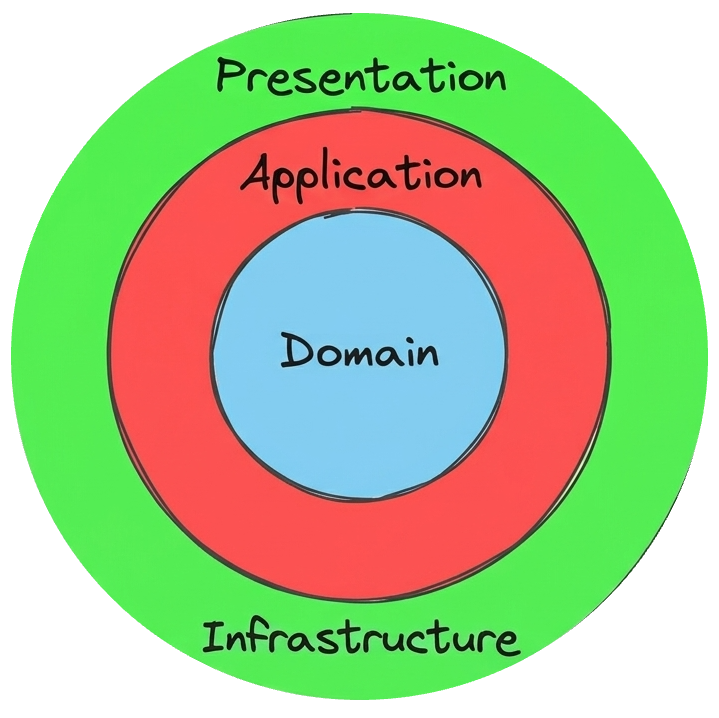
Clean Architecture Diagram
Presentation
React components · ViewModel hooks
Application
CQRS · Use cases
Domain
Entities · Domain services
Infrastructure
Third party dependencies
The rule
Dependencies only point inward.
Domain knows nothing about React.
Infrastructure knows nothing about UI.
What you build
CSV product import flow
Draft & publish management
Full unit + integration tests
NX monorepo + generators

The architecture skills
front-end was never taught.

React teaches you the tool. Clean Architecture teaches you where things belong. Most front-end codebases aren't hard to work with because the developers are bad — they're hard because nobody introduced a structure that scales.

Business logic you can test without a browser
When validation and domain rules live inside React components, you can't test them in isolation. This course moves that logic into pure layers — commands and domain services that run in milliseconds with no UI, no mocks, no ceremony.
Dependencies you can swap without a rewrite
LocalStorage today, an API tomorrow. When your code depends directly on third-party tools, every change ripples. Repository interfaces create a firewall — one implementation file changes, everything else stays green.
A codebase new developers can read on day one
Open a well-structured project and you see what it does, not a tangle of hooks, utils, and helpers. Explicit layer boundaries cut onboarding time and make code review faster for the whole team.
Features that don't slow down over time
Velocity drops when developers can't predict what a change will touch. Layer separation makes the blast radius of every change visible before you write a line. New features slot in without disturbing existing logic.

Fundamentals first.
Pragmatic always.

You'll learn the mindset and the vocabulary — what a domain is, what a use case is, why layers exist — and then immediately apply it by refactoring a real, messy React codebase into something you'd be proud to ship.

Clean Architecture layersWhat each layer owns, what it can't import, and why the rule matters in practice — not just in diagrams.
Domain entities & domain servicesHow to model your product's rules in pure TypeScript — no framework imports, no side effects, fully testable.
CQRS & application commandsHow to model use cases as commands that don't know about React — and why that makes them trivial to test and reuse.
Dependency injection in ReactHow to wire commands and repositories into components — so you can swap implementations and test without a real backend.
The Repository patternHow to define persistence boundaries that abstract where data goes — swapping LocalStorage for an API becomes a one-file change.
Unit & integration testingUnit tests for domain and commands. Integration tests for the repository. The right test at the right level — not everything mocked to oblivion.
NX monorepo & library structureHow to enforce layer boundaries structurally — so a junior developer literally can't import infrastructure code into the domain by mistake.
Testable ViewModel hooksHow to extract UI logic into hooks tested — without rendering a single component or touching the DOM.

Two modules.
One complete refactor.

Every lesson builds something real. You start with a messy components and end with a fully layered, tested application. The same codebase — refactored step by step.

01
From messy component to testable architecture
Domain · Application · Presentation · Unit tests — working UI, no real persistence needed
Module 1
Course Orientation: Summary of the architectural goals and a complete starting code walkthrough.
The Architecture Blueprint: Intro to Clean Architecture, optimal folder structures, and why a monorepo is mandatory for modern projects.
The Component Trap: A deep dive into why writing business logic directly in UI components cripples scaling, and a critical note on security.
Isolating the Domain: Defining what the Domain layer actually is, writing your first domain types, and executing a safe refactor.
The Business Core: Creating pure domain services and writing isolated unit tests for them.
Legacy Refactoring Strategies: Real-world tactics for safely migrating and cleaning legacy code without breaking production.
Evolving the View: Moving UI-specific logic into clean hooks, creating highly testable presentation components.
Decoupling via Dependency Injection (DI): What DI actually is, why it is vital for testing, and refactoring a main page to use it.
Component Organization: Best practices for writing, organizing, and maintaining production-ready React components.
Handling Product Variations: Refactoring your system for multi-variant products, modifying the structure, and keeping tests green.
Conclusion / Recap: Core takeaways on domain separation.

02
Infrastructure — real persistence without breaking anything
Repository implementation · Integration tests · Composition root — Module 1 code untouched
Module 2
Module Overview: Moving past UI hooks into true application workflows.
The Hook Illusion: Why simply shifting code from a component into a custom React hook does not actually solve your architectural technical debt.
Mapping Intentions: Identifying concrete user stories and translating them into standalone application use cases.
CQRS Patterns: Introduction to Command Query Responsibility Segregation and creating your first application query.
Testing Use Cases: How to test application commands and queries rapidly without a DOM or network layer.
The MVVM Blueprint: How the Model-View-ViewModel pattern bridges the gap between raw application data and UI state.
The Infrastructure Layer: Mapping the "how" of your system and abstracting away third-party dependency blast radiuses.
Concrete Implementation: Writing robust adapters for external libraries and utilizing more robust DI system.
Connecting ViewModel: Wiring commands, queries directly into the ViewModel, and testing the resulting flow in isolation.
Conclusion / Recap: Takeaways on use cases and infrastructure boundaries.
03
Abstracting Away the Framework
Moving your application lifecycle completely out of the React ecosystem.
Module 3
Module Overview: Escaping the bounds of a single UI framework.
The State Problem: Rethinking global state and understanding why your core logic needs to live entirely outside of React.
Signals Framework: Introduction to Signals, managing complex async logic, and moving the ViewModel outside the React lifecycle.
The Repository Pattern: Why you must abstract your data-fetching layer, creating your first repository, and refactoring commands to use it.
Cross-Platform Execution: Introducing a NodeJS CLI application to demonstrate total framework independence.
Reusing code in NodeJS: Implementing Node-compatible repositories and executing your existing React-designed queries directly in a CLI backend.
Conclusion / Recap: Takeaways on total framework detachment.
+
Starter template & NX generators included
The finished codebase, polished and documented. Generators that scaffold domain libraries and entities in seconds.
Bonus

This syllabus represents the planned curriculum and learning objectives. To ensure the highest quality educational experience and to reflect evolving industry best practices, we reserve the right to modify, adapt, or reorder the course modules, code examples, and lesson topics at any time.


Right fit
  • React developers whose codebases are getting harder to change with every sprint
  • Tech leads who need a shared structure the whole team can follow consistently
  • Senior developers who know something is wrong but can't name the pattern that fixes it
  • Teams that want to write tests but find their code too coupled to test anything usefully
Not the right fit
  • Complete beginners — you should be comfortable with React hooks and component state first
  • Projects that will stay small — the patterns pay off at scale
  • Developers looking for a component library or design system — this is about structure, not UI

Get notified
at launch.

Join the waitlist — you'll be first to know when the course goes live, plus an early-bird discount before it's public.

No spam. Unsubscribe anytime.